


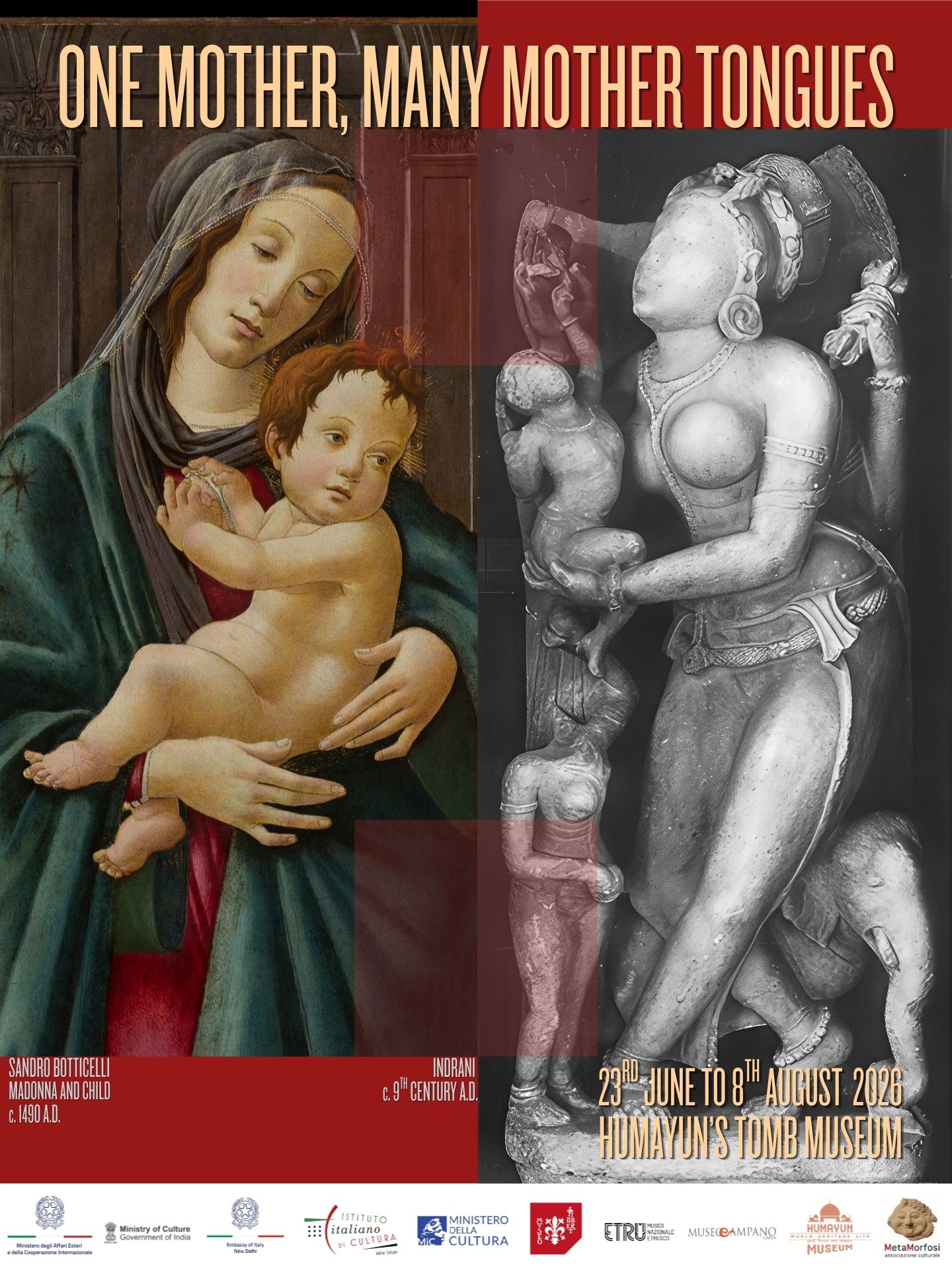
The exhibition arises from a simple yet far-reaching intuition: across distant epochs and geographies, the image of the mother and child persists as one of the most enduring visual narratives in human history. From the votive figures of Mater Matuta in ancient Rome to the representations of Hariti in the Indian world, and ultimately to the Madonnas of the Renaissance, a thread of iconographic and symbolic continuity unfolds—linking the Mediterranean to Asia, pagan cosmologies to Christian theology, myth to devotion.
The statues of Mater Matuta, produced in central Italy between the 6th and 3rd centuries BCE, present seated female figures holding one or more children upon their laps. These are not merely intimate images of motherhood; rather, they embody a principle at once cosmic and civic. Mater Matuta, goddess of dawn and birth, presides over the regeneration of both life and city. The maternal gesture—cradling the child—articulates a dual meaning: it is at once protection and projection, the safeguarding of life and the promise of continuity, both biological and political.
In the Buddhist tradition, Hariti—once a child-stealing demon, later converted by the Buddha into a benevolent guardian—is similarly depicted enthroned and surrounded by children. Her transformed body becomes a site of redemption: a figure of threat transfigured into one of care and healing. Across India and Central Asia, her iconography shares with Mater Matuta a striking formal resonance: the frontal stillness, the seated authority, and above all the centrality of the maternal body as a generative and symbolic locus.
With the Italian Renaissance, this enduring motif acquires a new inflection. In the Madonna and Child by Sandro Botticelli, the relationship between mother and son unfolds within an intimate, suspended temporality. The delicacy of gesture, the quiet exchange of gazes, and the restrained tenderness introduce a psychological depth that does not diminish, but rather intensifies, the sacred dimension. If in earlier representations motherhood appears as a collective and archetypal emblem, here it becomes an inward, emotional, and spiritual experience.
The exhibition proposes a comparative reading that does not attempt to trace direct genealogies, but instead reveals profound correspondences: the seated posture as a natural throne, the child as both vulnerability and futurity, the female body as a threshold between the earthly and the transcendent. Through sculptures, paintings, and carefully constructed visual juxtapositions, it demonstrates how the archetype of the mother and child evolves without ever dissolving, adapting itself to the symbolic languages of different cultures.
Within this continuum, Botticelli does not mark a rupture but a transformation. His Madonna emerges as the unwitting heir to an ancient and far-reaching lineage: within the contemplative stillness of Renaissance painting, one can still perceive the distant resonance of archaic deities and the sacred mothers of Asia.
Ultimately, the exhibition invites the viewer to recognise, beyond differences of faith and form, a shared and universal narrative: motherhood as an originating act—a gesture that binds fragility to hope, memory to becoming, and the human to the sacred.
Timings: Tue-Sun 10:00 am to 7:30 pm (Monday closed)